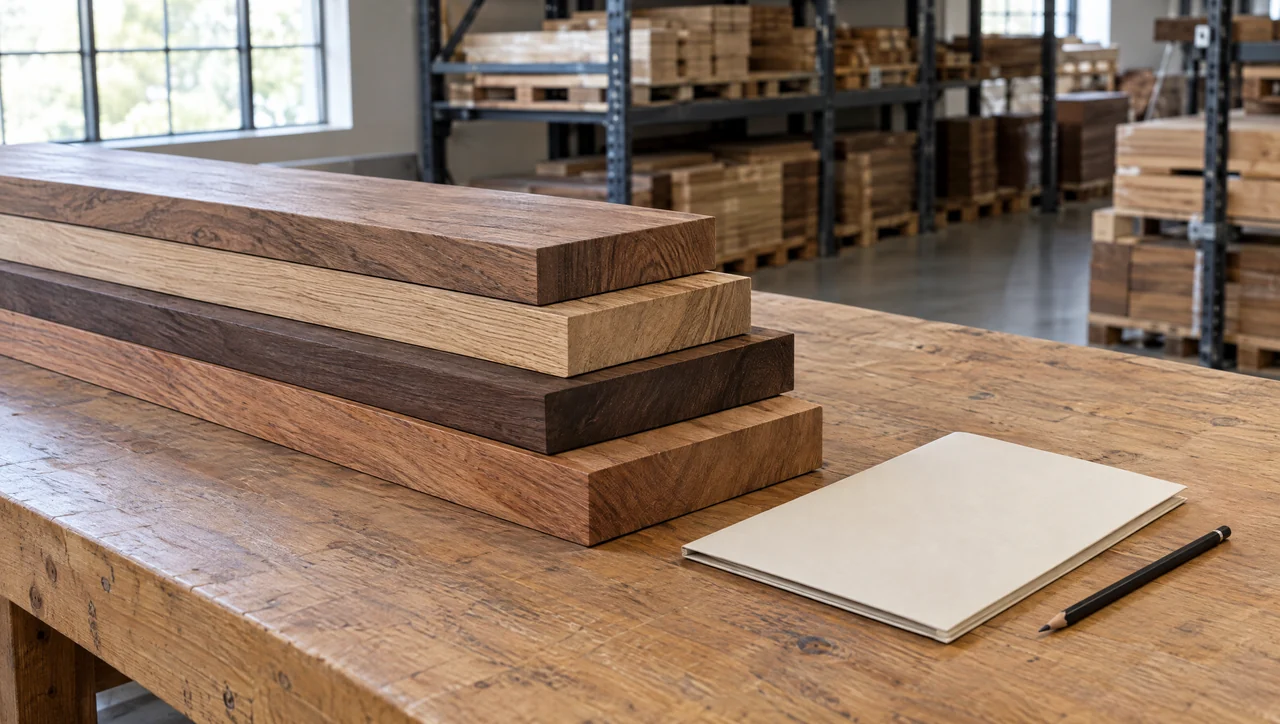
Boards and a quote folder arranged for a purchasing review.
Illustrative purchasing context. No price, grading rule or available stock is established by the image.Name the billing unit
Linear feet measure length. Square feet measure an area on a stated width or coverage basis. Board feet express volume, with one board foot equivalent to 144 cubic inches. A piece price purchases a stated piece. Confirm the seller’s tally rules rather than assuming a geometric conversion reproduces the invoice.
Use the correct dimensions
For a BF comparison, enter the documented billing thickness and width. Those may differ from the finished usable dimensions. For covered area, use the effective face appropriate to the installed profile. Keep billed quantity and usable output separate: one explains the charge, the other explains what that charge can accomplish.
Compare the full offer
Normalize the material amount, then add freight, fees and the applicable quoted tax. Check grade, length distribution, milling and exclusions before comparing totals. A calculator can put numbers on a common basis, but it cannot make two different products equivalent.
Put unlike quotes on the same worksheet
Start with the seller's original unit and preserve it. A conversion is a comparison aid, not a replacement for the quoted billing terms. If one offer is per linear foot and another is per board foot, record the thickness and width used for the board-foot tally before comparing rates. Finished dimensions do not necessarily establish that commercial tally.
For a rectangular billing basis, board feet per linear foot equal billing thickness in inches × billing width in inches ÷ 12. A hypothetical 1-inch by 6-inch billing section contains 0.5 board feet per linear foot. An offer at $12 per board foot therefore equates to $6 per linear foot on that basis. If the seller instead bills a 0.75-inch by 5.5-inch section, the factor is 0.34375, giving $4.125 per linear foot at the same board-foot price. Those are two different billing assumptions, not two prices for a verified product.
Separate the invoice unit from the installed result
A square-foot quote deserves particular attention. Does the seller mean nominal board width, finished overall width, net exposed face, or installed coverage? Grooves, tongues and overlaps can make those answers materially different. Ask for the basis in writing instead of working backward from a rounded total.
Suppose a fictional board costs $5 per linear foot and has a documented 5-inch installed coverage. Twelve inches divided by 5 inches gives 2.4 linear feet per square foot of covered area, so the material rate is $12 per covered square foot before cutting losses and other charges. Using a 6-inch nominal width would produce $10 and understate that particular comparison. This is pricing arithmetic; the example does not prescribe an actual profile or installation.
| Quoted unit | Needed before conversion | Useful comparison result |
|---|---|---|
| Linear foot | Exact product and length restrictions | Rate per length of the same supplied section |
| Board foot | Seller's thickness and width tally | Equivalent LF rate on that billing basis |
| Square foot | Width or coverage definition | Cost per comparable installed area |
| Piece | Piece length, count and dimensions | Piece total and equivalent LF rate |
| Bundle | Actual tally and bundle restrictions | Bundle total with its usable contents |
Keep rounding from changing the conclusion
Use unrounded conversion factors until the final display. A rate rounded to cents before multiplication can differ from the seller's invoice calculation over a large quantity. Retain the original quote total as the commercial record, and label any normalized total as your comparison. If the difference is larger than rounding explains, ask whether fees, quantities or tally conventions changed.
The most useful output is a side-by-side scope comparison: same material description, same effective quantity, same delivery basis and separately identified extras. A lower converted rate is not a better offer if it buys a different grade or excludes required milling. Read quote scope before ranking the offers. NIST SP 811 supplies unit conventions; it does not define a seller's lumber billing practice.
A PURCHASING CALCULATION
A purchasing calculation
A fictional offer of $5 per LF and another of $10 per SF are not directly ranked. If the SF billing basis is 5.5 inches wide, the second rate corresponds geometrically to about $4.58 per LF before other charges. Different billing widths or excluded services change that comparison.
Your review record
0 of 4 questions reviewed
A checked box records your review. It is not a professional approval.