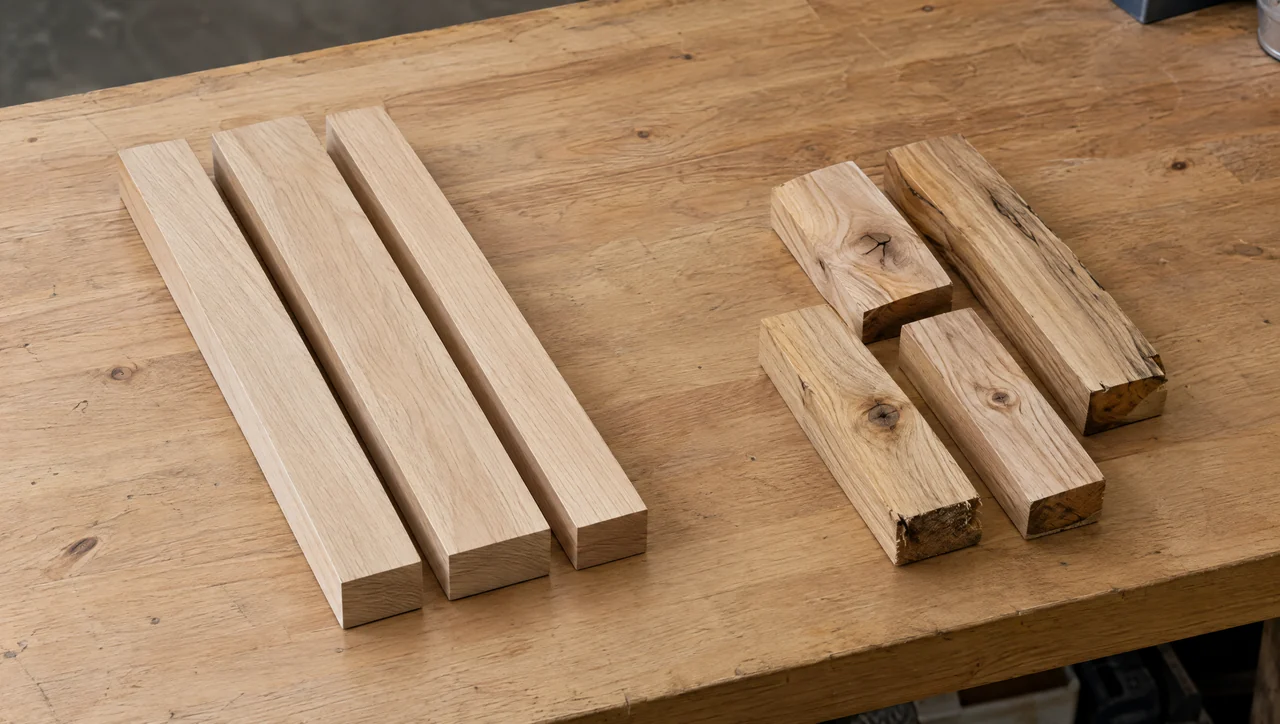
Wood pieces sorted by visible surface condition.
Illustrative purchasing context. No price, grading rule or available stock is established by the image.Define acceptable material
The project’s appearance, cutting and performance requirements determine which material can be used. A grade name alone may not express every project requirement. NHLA grading resources explain the role of established hardwood grading rules; a site calculator cannot inspect and grade the actual pack.
Treat loss as an assumption
The comparison tool lets you enter an unusable proportion to explore its effect. That number is not a claim about a species, supplier or grade. It can represent a planning scenario for cutting and selection, but the actual cutting list and inspected material are needed to establish realized yield.
Do not buy a percentage in isolation
A cheaper pack with a different length mix or grade may work well for short parts and poorly for long uninterrupted runs. Compare the material against the actual task. Keep allowance assumptions attached to the exported record so another reviewer can change them rather than accept the result as guaranteed.
Decide what the purchased material must produce
The lowest bundle price can be expensive if it produces fewer acceptable parts. Start with the required result: finished dimensions, visible faces, permitted characteristics and any appearance matching. A grade name alone may not express all of those requirements. Ask how the seller describes the supplied grade and what exclusions or selection services apply to the offer.
Usable yield is the portion of purchased material that can serve the defined job. It changes with part lengths, appearance requirements, defects, trim and the opportunities to reuse shorter pieces. It is not a permanent property of a species. The same bundle can be economical for short components and poor value for long uninterrupted faces.
Calculate yield on one consistent basis
Suppose a hypothetical purchase contains 1,000 linear feet of one section and costs $5,000 before delivery. If the approved parts consume 850 usable linear feet, the material cost is about $5.88 per usable linear foot. At 700 usable linear feet it is about $7.14. The quoted rate remains $5 per purchased linear foot in both cases; the job result changes.
Keep the numerator and denominator aligned. Do not divide a whole delivered-order total by the usable quantity from only one line item. Do not compare linear-foot yield across unlike sections without separating them. If the question concerns cost per installed area, convert the usable pieces using the documented coverage basis after reviewing the lengths and layout.
| Purchasing question | Evidence to request |
|---|---|
| Are long clear faces required? | Offered length distribution and applicable appearance description |
| Can short pieces serve the job? | Finished part schedule and permitted joints |
| Is color sorting included? | Written selection scope and limits |
| Are all faces equally important? | Face designation and agreed acceptance criteria |
| What happens to disputed material? | Inspection and claim procedure in the offer |
Use samples for the question they can answer
A sample can help agree on appearance, but one attractive piece does not establish the yield of an entire delivery. Keep the sample identification and the scope of the approval: color range, texture, milling or another specific feature. If a project needs selected appearance across many boards, request that service explicitly rather than assuming the sample represents a sorting commitment.
For a repeat purchase, recorded results from a comparable prior order can improve planning. Note what changed: part length, grade description, visible-face requirement or cutting method. A previous yield percentage is informative only when those conditions remain relevant. Do not present one project's selection loss as an industry standard.
Compare two offers with the uncertainty visible
Use a reasonable, stated yield scenario for each offer and calculate the cost per usable result. Then test a less favorable scenario. If a small yield change reverses the ranking, the useful next step is better product or grading information, not a more precise-looking total. An unresolved yield should remain an assumption on the worksheet.
The milling-and-services guide helps separate supplied preparation from work left to the buyer. The calculations here are original purchasing examples. They do not assign a grade, guarantee recovery or replace the seller's written material description.
A PURCHASING CALCULATION
A purchasing calculation
A hypothetical 500 square feet of purchased effective coverage at a 10% unusable proportion gives 450 square feet of assumed usable coverage. This is a reduction of purchased output, not the same formula as adding 10% to a required quantity.
Your review record
0 of 4 questions reviewed
A checked box records your review. It is not a professional approval.