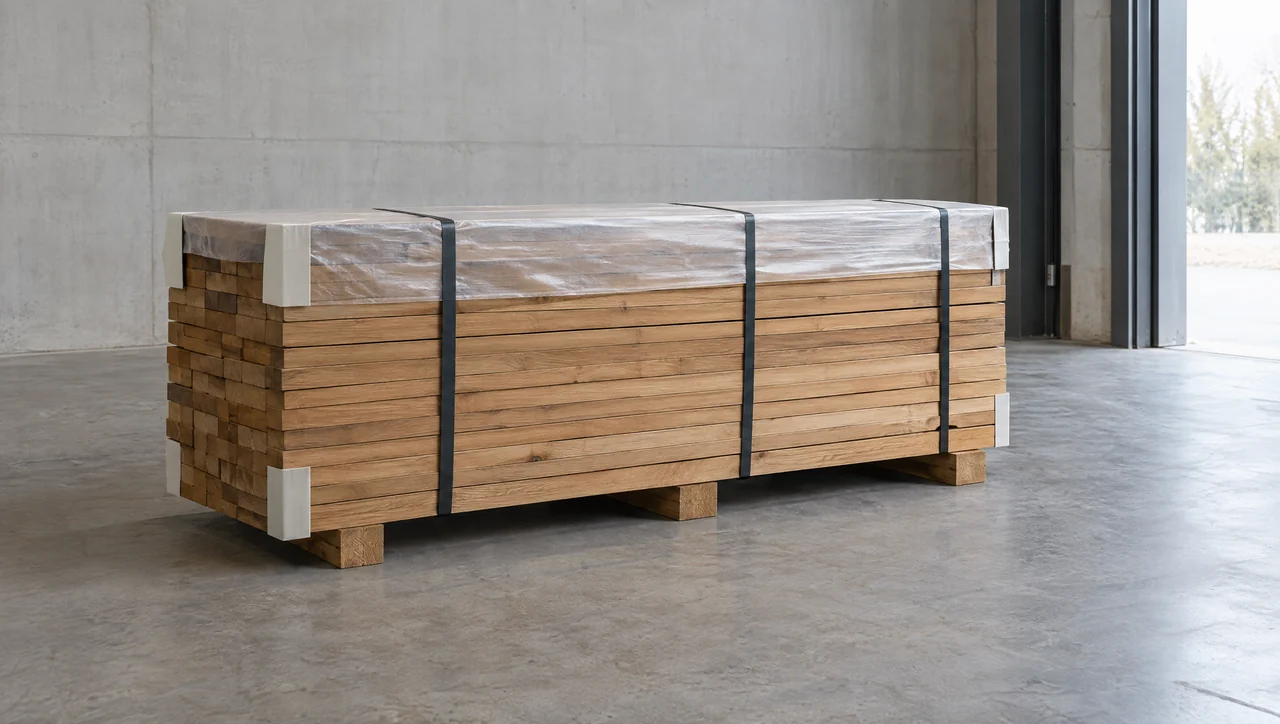
A timber bundle staged at a dry loading bay.
Illustrative purchasing context. No price, grading rule or available stock is established by the image.Ask for the length information
A bundle with enough total length may still lack the lengths needed for long runs. Request the available distribution or the exact-length commitment where relevant. Do not infer it from a photograph of bundled lumber or a total board-foot quantity.
Separate pieces from length
A piece-price quote needs a stated piece length. The comparison tool rounds the required linear feet up to whole pieces of that length. It does not optimize cuts or account for saw kerf, defects or required end trimming. Those belong in a reviewed takeoff or cutting schedule.
Value useful offcuts honestly
An offcut reduces waste only if it can serve a real remaining part under the project’s requirements. Unassigned leftovers are not automatically savings. Record whether the offer contains long lengths, random lengths, cut-to-length material or minimum quantities, and compare the result to the project’s needs.
A thousand linear feet does not describe the bundle
An order total can hide the feature that matters most to a project: the lengths of the individual boards. Ask for a fixed-length schedule, a documented random-length range, or the supplier's proposed tally, depending on what is being offered. The phrase random lengths does not promise the particular mix your layout needs.
Before requesting a quote, identify the parts that require continuous material. Separate them from short returns, trim or components that can use remnants. A supplier can price a clear request more meaningfully than an undifferentiated footage total. If the layout depends on unusually long pieces, keep their quantity and acceptable alternatives visible as their own line.
Compare the cost of the required result
Consider two fictional offers for 600 linear feet of the same section. Offer A is $4.50 per linear foot in an unspecified mix. Offer B is $5 per linear foot with the long pieces needed for the job explicitly included. The totals are $2,700 and $3,000 before extras. A is $300 less only if its mix can produce the scheduled parts without another purchase or an unapproved layout change.
If A needs an additional $420 of confirmed long stock to complete the same scope, the material comparison becomes $3,120 against $3,000, before considering any usable leftovers. Keep the additional stock and remaining short pieces in the record. Do not hide the first order's surplus by assigning it a resale value that no one has established.
Ask these questions before comparing rates
- Which lengths are fixed commitments, and which are subject to the final tally?
- Is there a stated minimum or maximum length, and does the quote identify the distribution within that range?
- Are long-length selection charges included in the headline rate or listed separately?
- Can the supplier offer a proposed mix against the required parts schedule?
- What changes to price, freight or lead time require a revised quote?
When a tally arrives, compare counts as well as total footage. A line for ten pieces at 12 feet is different from a note saying 120 feet with no piece schedule. Retain both the supplier's product descriptions and your destination labels so the commercial record and the fabrication plan can be reconciled.
Do not let a low rate rewrite the design unnoticed
Shorter stock may be a sensible alternative when the design permits joints or when separate small parts can use it. That is a deliberate scope choice. Identify who can approve the changed layout and compare the complete resulting purchase. The price worksheet should record the change, not silently assume every continuous component can be assembled from offcuts.
Likewise, buying all long boards is not automatically economical. Some jobs create more unused remnants that way. The relevant comparison is the offered stock against the actual parts, with cutting and selection requirements attached. This site explains the commercial consequences; the exact cutting arrangement belongs in the project takeoff.
After delivery, reconcile the received lengths with the agreed tally before mixing packs. If there is a discrepancy, record the specific line, count and length while the package labels remain available. That produces a concrete commercial question rather than a general complaint that the order seems short. Continue with the quote-scope checklist.
A PURCHASING CALCULATION
A purchasing calculation
A project needs ten uninterrupted 12-foot runs. A pack containing 120 total linear feet of 8-foot boards cannot satisfy that requirement without joints. The quote comparison must preserve the run requirement instead of treating equal LF totals as equivalent.
Your review record
0 of 4 questions reviewed
A checked box records your review. It is not a professional approval.